


Selecting an engineering consultant requires matching project scope to a firm’s specific expertise. Rosenberg Associates, a Southern Utah firm founded in 1989, fields a 17-person team licensed across civil, structural, surveying, geotechnical, and environmental disciplines. Clients should verify licensure, local experience, and in-house capabilities before engagement.

Key Takeaways

  • Verify professional licensure, local project history, and in-house technical capability before engaging any engineering consultant.
  • Confirm the firm’s physical presence and operational history in Southern Utah, not merely a satellite office.
  • Review completed projects on comparable terrain with similar soil and drainage conditions to avoid design failures.
  • Assess in-house capabilities across all needed disciplines to prevent subcontracting delays and coordination gaps.

What defines your project's engineering needs?

Engineering projects demand precise upfront definition. A project’s scope determines which technical disciplines must contribute. Engineering is an extremely broad field with multiple areas of specialization. Consultants typically specialize in one area or a set of closely related ones. Misidentifying those needs triggers costly redesigns and schedule delays that erode project viability.

What engineering disciplines does a typical development project require?

Most development projects need multiple engineering specialties working in coordination. A commercial subdivision rarely succeeds with civil engineering alone. The site demands grading and drainage design. The structures require independent analysis. Underground utilities need mapping and verification.

Rosenberg Associates offers a wide array of engineering services spanning civil engineering, structural engineering, survey and mapping, geotechnical and environmental engineering, and construction engineering. Civil engineering services cover site layout, grading and drainage design, utility and street improvements, master planning, subdivisions, and public recreation space development. Each discipline addresses a distinct risk. Skipping one leaves a gap that regulatory review or field conditions will expose.

How should a project manager handle overlapping engineering requirements?
Projects with overlapping requirements benefit from a multidisciplinary assessment. A single-discipline consultant solves one problem while leaving adjacent issues unresolved. When consulting needs encompass multiple areas or the path forward remains unclear, engaging a consulting firm to assess requirements and assemble a multidisciplinary team prevents fragmented deliverables. The firm evaluates the full project scope. It identifies every required discipline. Then it deploys the right specialists in the correct sequence. This approach eliminates the coordination gaps that inflate budgets and extend timelines.

How do you verify local expertise and licensing?

Verifying local expertise and licensing protects project timelines and budgets from costly regulatory delays. A firm lacking Southern Utah credentials exposes developers to permit rejections and construction stoppages that drain capital without producing progress. The verification process requires examining three distinct dimensions: professional licensure, documented local project history, and specialized technical capability.

What licenses should an engineering firm hold in Southern Utah?

Professional engineering licensure forms the non-negotiable baseline. Rosenberg Associates maintains state licensing across multiple states, enabling seamless project execution throughout the Intermountain West. The firm’s multi-disciplinary licensed team includes professionals in civil, structural, surveying, geotechnical, and environmental disciplines. This breadth eliminates the coordination gaps that occur when developers piece together separate consultants for each engineering specialty.

How does local experience affect project outcomes?

Southern Utah’s terrain presents unique challenges that out-of-region firms consistently underestimate. Rosenberg Associates, a locally owned and operated civil engineering firm based in Southern Utah since 1989, has accumulated decades of direct experience with the region’s problematic soil conditions. The firm’s geotechnical team has successfully addressed expansive, collapsible, soluble, and wet soils, along with undocumented fill and buried debris. Firms without this specific local knowledge routinely produce designs that fail during construction.

Verification steps follow a logical sequence:

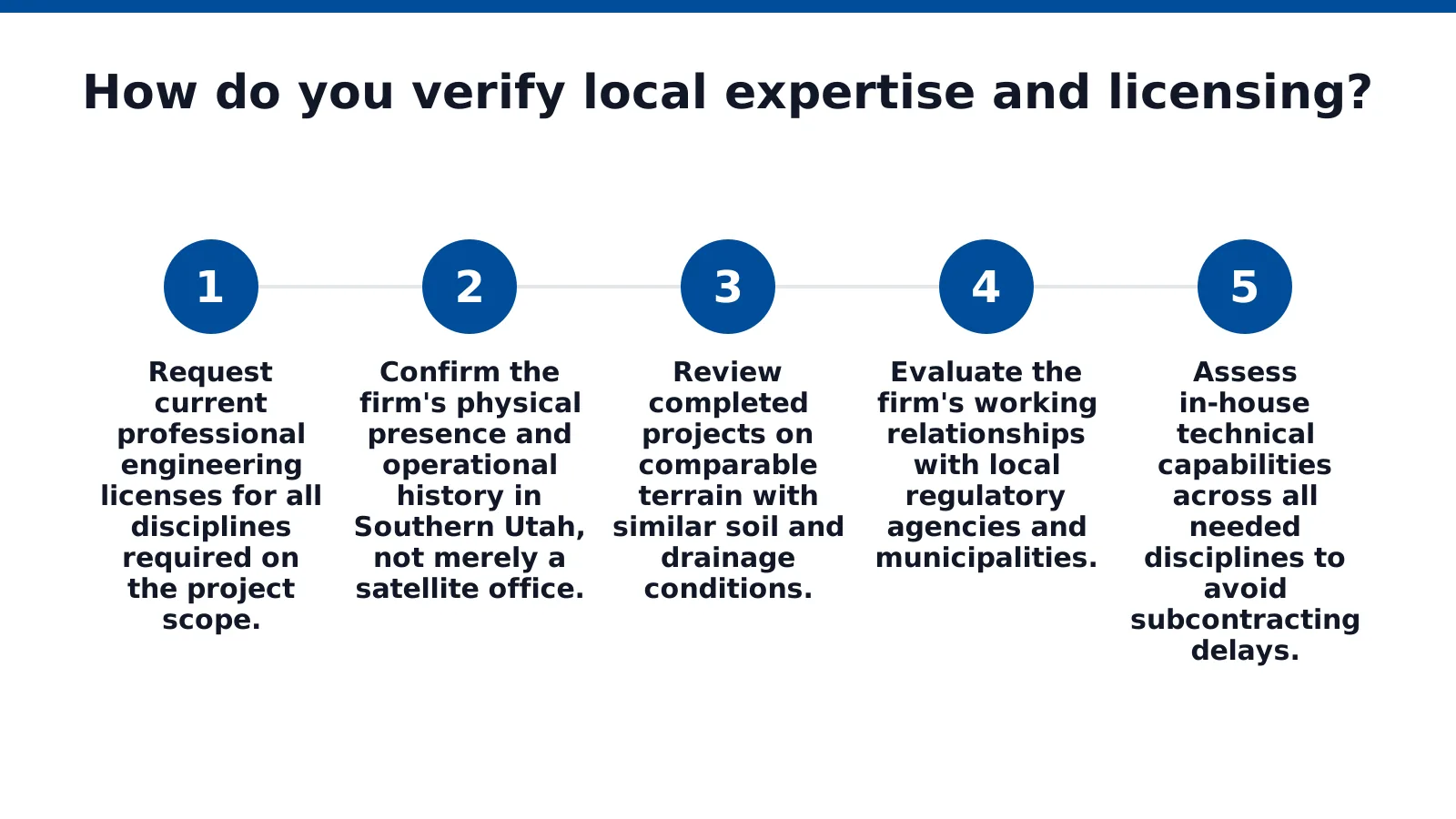
  1. Request current professional engineering licenses for all disciplines required on the project scope.
  2. Confirm the firm's physical presence and operational history in Southern Utah, not merely a satellite office.
  3. Review completed projects on comparable terrain with similar soil and drainage conditions.
  4. Evaluate the firm's working relationships with local regulatory agencies and municipalities.
  5. Assess in-house technical capabilities across all needed disciplines to avoid subcontracting delays.

The firm’s delivery model combines in-house technical expertise with close collaboration with clients and regulatory agencies. This integrated approach ensures designs meet local standards on first submittal. More information about the firm’s qualifications and history appears on the Rosenberg Associates about page.

What red flags indicate insufficient local expertise?
Warning signs include reliance on out-of-state soil data, unfamiliarity with local municipal codes, and inability to reference specific Southern Utah project examples. A consultant who cannot discuss local geologic conditions in detail lacks the foundation for sound engineering decisions.

What questions should you ask a prospective firm?

A prospective firm’s answers reveal whether its expertise aligns with project requirements. Developers and municipal planners who skip this vetting process risk costly redesigns, extended timelines, and regulatory setbacks that erode project viability.

What specific engineering disciplines does the firm practice in-house?

Firms with multiple in-house disciplines eliminate coordination gaps between specialties. Rosenberg Associates provides structural engineering for residential, manufacturing, and light commercial applications using innovative modeling software, AutoCAD interfacing, and a comprehensive database of structural details. The company also maintains strong working relationships with local area utility service providers and has engineered major utilities including developing new utility corridors, relocating existing utilities, and upgrading utility infrastructure. Single-discipline firms often subcontract critical work, introducing delays and communication breakdowns.

How does the firm handle field coordination when conditions change?

Field conditions frequently dictate last-minute changes to plans, methods, or materials. Coordination efforts must extend past the drawing board and into the field. Responsive team support reaches the construction contractor directly. Without this capability, a project stalls while revised drawings cycle through off-site review. Rosenberg Associates delivers that field-level responsiveness, ensuring contractors receive immediate guidance when unexpected conditions emerge.

Can the firm identify problems beyond the initial scope?

Clients hire a consultant for specific expertise, but after assessing the situation, consultants often recognize that the problems require a different skill set entirely. A firm that rigidly adheres to the initial scope misses critical interdependencies. The right consultant diagnoses underlying issues and adjusts the approach accordingly, preventing expensive rework later in the project lifecycle.

How do you evaluate past project performance?

Evaluating past project performance requires examining completed work against the specific demands of Southern Utah’s terrain and regulatory environment. A firm’s portfolio reveals whether its engineering solutions hold up under real construction conditions.

Rosenberg Associates has shaped master-planned communities including Sunbrook, Sun River St. George, Coral Canyon, and Elim Valley. These projects demonstrate the firm’s capacity to deliver at scale across residential and mixed-use developments.

What project types should a portfolio include?

A credible portfolio spans multiple disciplines rather than a single specialty. Rosenberg Associates’ civil engineering work covers land use master planning, residential subdivisions, commercial and industrial site development, roads and streets, major utility infrastructure, and parks, trails, and open space. This breadth signals the firm can manage complex, multi-phase projects without outsourcing core technical work.

How do technical capabilities factor into performance evaluation?

Technical depth separates firms that design from firms that verify. Rosenberg Associates collects and tests representative soil samples in its in-house laboratory, identifies potential geologic hazards, describes the engineering geology, and makes design recommendations presented in a geotechnical report. The firm’s drone mapping services leverage fixed-wing and multirotor systems for cost-effective, precision mapping. These capabilities reduce reliance on third-party vendors and keep project timelines under direct control.

Review parks and recreation case studies to assess how site-specific design performs in Southern Utah’s desert landscapes.

What common mistakes should you avoid?

A key element of success is hiring the right professional for the task. Failing to define the specific area of engineering needed remains the most frequent and costly error. Commercial developers and municipal planners lose time and budget when a generalist tackles a specialized problem.

Why is a vague project scope dangerous?

An undefined scope leads directly to budget overruns. What to ask an engineering firm st george includes detailed questions about their discipline-specific expertise. Consultants must develop the ability to understand clients’ problems, empathize with their pain, and find solutions, as Stuart B. Brown of Veryst Engineering advises. Without this diagnostic skill, the consultant addresses symptoms rather than root causes.

Common mistakes to avoid include:

  • Skipping the definition of the precise engineering discipline required
  • Hiring based on availability rather than documented expertise
  • Neglecting to verify the firm's cost-estimating methodology
  • Accepting proposals that lack software-specific deliverables

How does informal estimating undermine your project?

Informal estimates cause budget failure. Hire civil engineering firm st george that applies a formal classification system. Rosenberg Associates uses the AACE International five-level classification system, which increases in accuracy from preliminary design through tendering. Civil engineering construction cost estimates cover site layout, grading and drainage design, and utility and street improvements. AutoCAD and Civil 3D software drive that accuracy. A firm without this framework delivers unreliable numbers.

The engineering consultant checklist st george 136 must include software proficiency. Select an engineering firm southern utah 136 demonstrates technical rigor through its tools and standards. Project owners who skip this verification inherit schedules built on guesswork. Firms applying the AACE system protect budgets from that outcome. Knowing how to choose engineering consultant st george 136 means demanding documented estimating procedures, not verbal assurances.

FAQ

What licenses should an engineering consultant in St. George hold?

Rosenberg Associates holds professional licensure across civil, structural, surveying, geotechnical, and environmental disciplines.

How do I verify a firm’s local experience in Southern Utah?

Review completed projects on comparable terrain with similar soil and drainage conditions, and confirm the firm’s physical presence and operational history in Southern Utah.

Why is in-house capability important when choosing an engineering consultant?

In-house capabilities across all needed disciplines prevent subcontracting delays and coordination gaps that inflate budgets and extend timelines.

Conclusion

Selecting an engineering consultant demands verification of discipline-specific licensure, in-house technical breadth, and documented estimating rigor. A firm that demonstrates field responsiveness, diagnostic capability, and a portfolio of completed local projects provides the foundation for predictable outcomes. Apply these criteria to your shortlist and proceed with the consultant whose capabilities match your project’s specific demands.